


DevOps delivery
The pipeline every build ships through.
Details


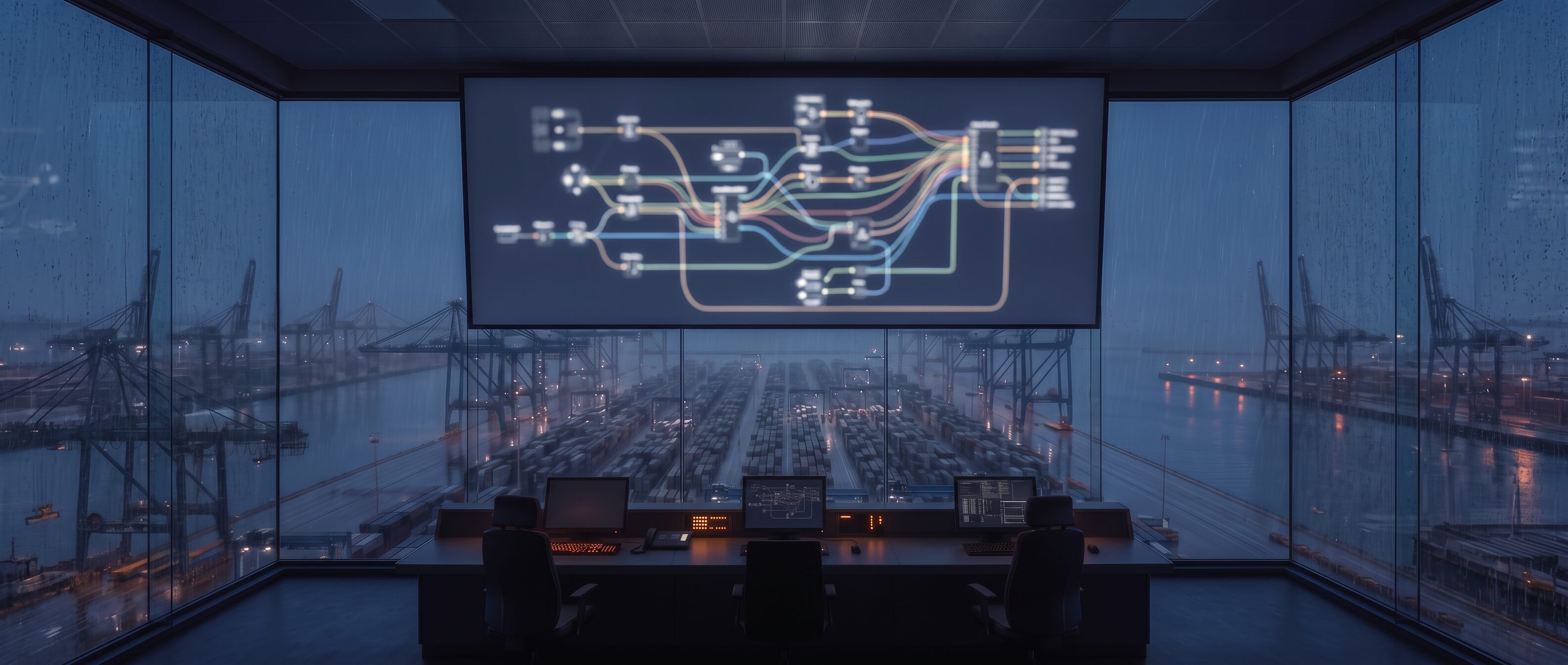
Application Development
Custom applications, APIs, and integrations, engineered by the team that operates production infrastructure every day.
How it works
The gap between a demo and a dependable system is operations. We close it by building software the way we run it. What lands on launch day is not a codebase; it is the application with everything it needs to be operated underneath it, on the cloud that will run it.
Instrumented code
Logging, metrics and alerting built into the software itself, so day one in production is observable.
Documentation and runbooks
Architecture records, operational runbooks and onboarding notes your engineers can pick up without us in the room.
Infrastructure as code
Environments defined in versioned, reviewable templates, so the system can be rebuilt, not just restored.
A named operations path
A rehearsed rollback plan and a defined route into managed operations, so ownership after launch is explicit.
How a build runs · every engagement
Working software at every checkpoint
01
Scope and architecture
The design is settled before the build starts: requirements, dependencies, data flows, and the operating model the software will live in.
02
Build in increments
Working software at every checkpoint, reviewed against the agreed scope. Logging, metrics and tests ship with the code, never after it.
03
Ship through guardrails
Releases go out through a governed pipeline: quality gates, staged rollout, and a rehearsed rollback path for every deployment.
04
Operate and evolve
After launch the software is monitored and operated around the clock, with a standing path for improvements from the team that built it.
What we ship
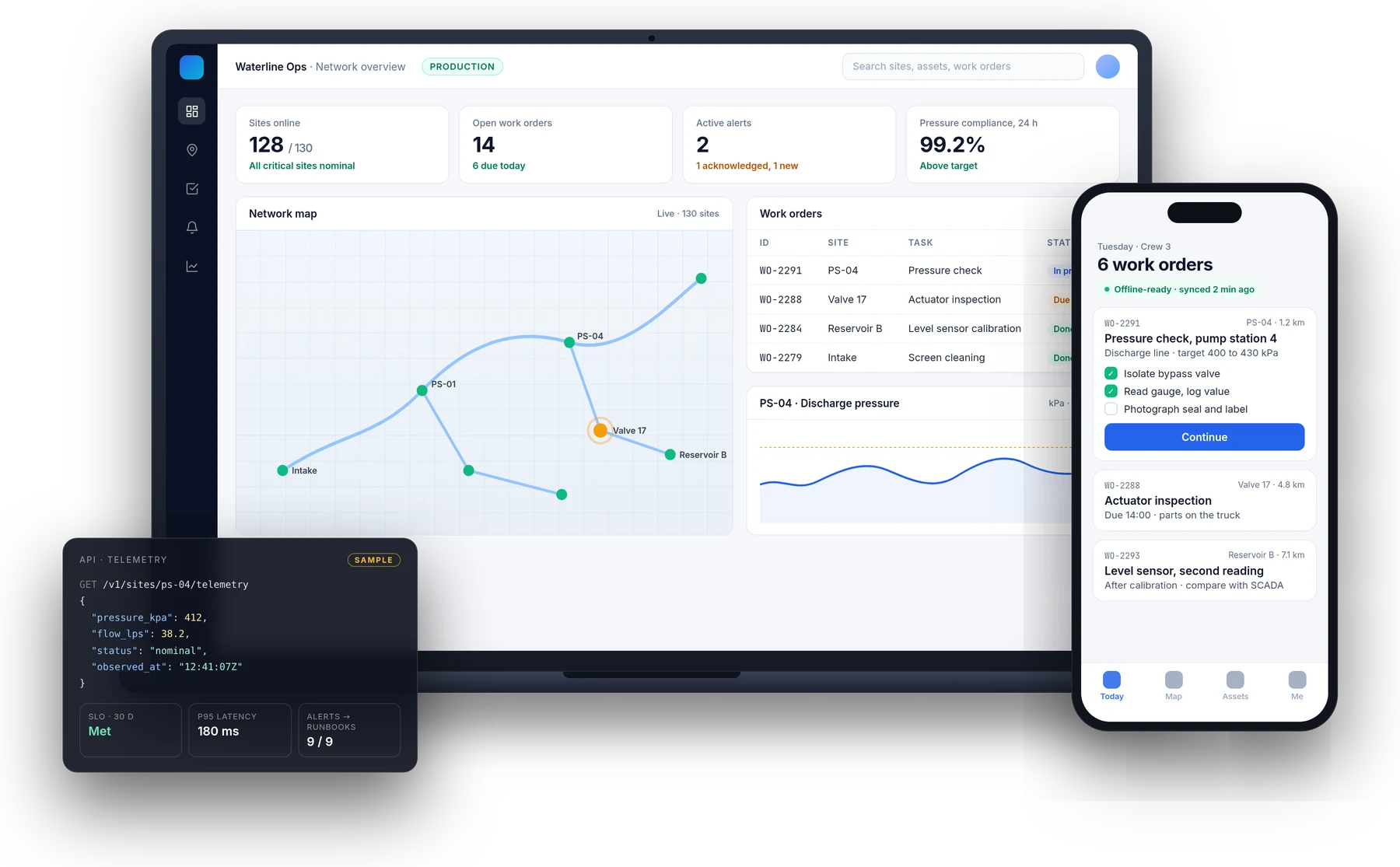
Web, mobile and API, designed and built as one product with its operations built in. This is what a CloudPresto build looks like when it lands: a field-operations system for a utility, shown here as a sample.
01
Designed with the people who use it
Field crews, operators and managers each get the surface their work needs.
02
Built to the standard on this page
One codebase, one API, one set of checks before anything ships.
03
Operated from day one
Health, alerts and runbooks are part of the product, running on our cloud.
What we build
Four kinds of work, one standard. Every engagement ships working software onto infrastructure that is monitored, hardened and operated around the clock.
Production-grade web applications, designed for reliability from the first commit.
Built for · A product the business runs on, not a prototype that grew.
Clean interfaces between your systems: designed, documented, versioned and monitored.
Built for · Systems that talk through spreadsheets and cron jobs.
Mobile experiences backed by the same hardened infrastructure as the rest of your stack.
Built for · An app whose backend nobody owns.
Legacy systems rebuilt into maintainable, cloud-ready services, business running throughout.
Built for · Code only one person understands.
What we build with
The default stack; yours where you have one
TypeScript · React
Web and product surfaces.
Node.js · Python
Services, APIs and workflows.
PostgreSQL
Data, replicated and backed up on the floor.
Kubernetes · Terraform
The platform, on our cloud, as code.
The standard
Production-ready is a property of every layer, not a final QA step. Every part of the stack, with what we build into it, and the checks a build passes before we call it done.
The stack
What users touch
Done means
Every check, on every build, before launch
01
Tests pass, with a coverage gate
At the threshold agreed for the system.
02
Scans clean, secrets in the vault
Dependencies and containers scanned; no static keys anywhere.
03
Performance budget met
Measured on the target environment, not a laptop.
04
Accessibility checked
On every customer-facing screen.
05
Observability wired
SLOs, dashboards, and alerts mapped to runbooks.
06
Handover pack complete
Reviewed at the last checkpoint.
07
Rollback rehearsed
On the release path, before the release.
08
Signed off at the checkpoint
By you, against the agreed scope.
Engagement
Scoped per engagement, priced to the deliverable. Whichever model, the same standard applies and the question of who runs it after launch is answered before launch.
| Per-project | Retainer | Dedicated team | |
|---|---|---|---|
| Shape | Fixed scope, phased delivery, explicit checkpoints. | A standing engineering lane for continuous build, improvement and support. | A dedicated team embedded in your organisation for the long run. |
| Best for | A defined product or system with a clear finish line. | A product that keeps evolving after launch. | A roadmap that needs a team, not a project. |
| Cadence | Reviewed at each checkpoint against the agreed scope. | A steady monthly lane, prioritised with you. | Your rituals, your backlog, our team inside them. |
| After launch | Handed to managed operations or to your engineers, with the runbooks. | Operated and improved from the same lane. | Operated by the team that built it. |
| Pricing | Priced to the deliverable. | Priced to the reserved lane. | Priced to the size of the team. |
How we work
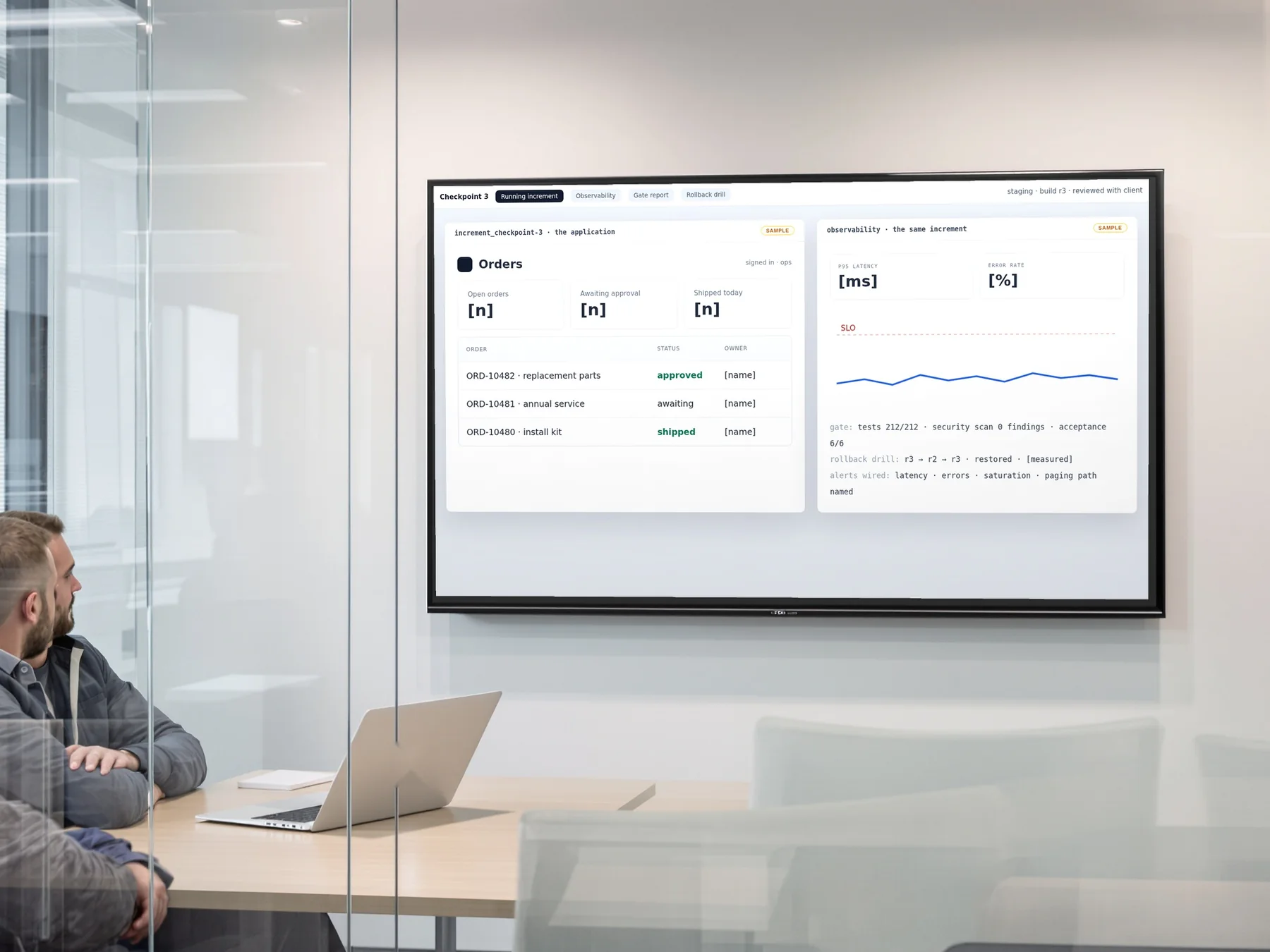
Not a slide deck. Every checkpoint is a review of running software against the agreed scope, with the same four things on the table each time. The design is settled first; working software starts once it is.
01
The running increment
Deployed to a real environment, reviewed as a user would use it, against the scope agreed for this checkpoint.
02
The observability view
Its logs, metrics and alerts, already wired, so the review sees the software the way operations will.
03
The test and gate report
What the pipeline ran and what passed: tests, security checks, acceptance criteria.
04
The rollback drill
The last release reverted and restored on purpose, so the way back is rehearsed before it is ever needed.
Get started
Open intake with a short description, or start with a scoped architecture conversation if the shape is still forming. Either way the design is settled first, and you see working software before the build is far along.
What the first conversation produces
01
The shape of the system
What it does, who uses it, what it talks to, and what it must never do.
02
The operating model
Where it runs, who runs it after launch, and what that costs to operate.
03
The engagement and the first checkpoint
Per-project, retainer or dedicated team, and what working software you will see first.
Go further
Collection
How software gets designed, delivered and operated the production-first way.
Guide
The CloudPresto service stack: what to start with and what to add.
Guide
Multi-stage pipelines with quality gates, automated testing and promotion.
Guide
Promotion gates, canary analysis and automated rollback.

