






Managed cloud
The operations loop that keeps the estate running day to day.
Details
Resilience Engineering
Continuity-first architecture with cross-region replication, distributed backups, and tested operational runbooks. Built to survive failures you haven't predicted yet.
How it works
Your workloads run across multiple regions on our own managed cloud, with continuous replication and isolated, immutable backups. No single region is a single point of failure.
Replication running. Your users are served from the primary region; every change reaches the standby region continuously.
Replicate, fail over, fail back
If a region degrades, traffic shifts to a healthy one and recovery is validated against your tiered RTO/RPO targets in quarterly drills.
Step through it
What is built in
It's engineered into the architecture from day one. Six capabilities in every environment, with the situation each is there for.
Geographically distributed backups, 3-2-1+1 in every package.
Built for · Backups that exist but have never been restored.
Continuous replication with repeatable failover procedures.
Built for · One region as a single point of failure.
Runbook exercises and restorations that prove recovery readiness.
Built for · Audits that ask for drill evidence: SOC 2, ISO 22301, PCI DSS, HIPAA, DORA.
Recovery targets by workload criticality, validated in restore tests.
Built for · Recovery targets set once and never tested.
Clear authority for failover, rollback and customer communication.
Built for · An incident at 3 AM with no agreed decision path.
Continuous assessment of survivability against evolving threats.
Built for · An estate that changed since the plan was written.
This is the floor for every system we run. Across the industry, it's sold as an add-on.
In every package
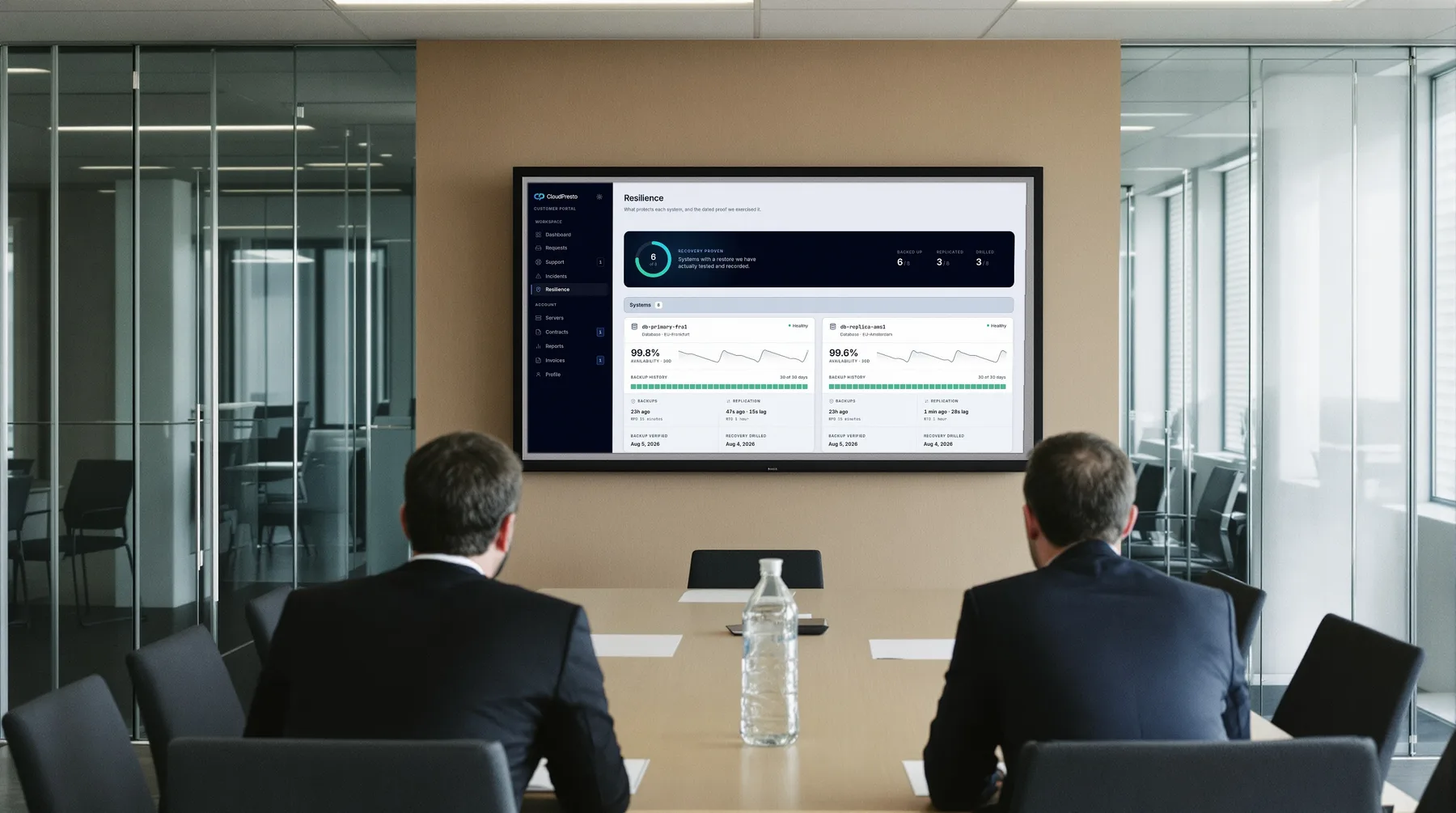
Every copy proves itself: restore verification runs against real snapshots, so the backup you count on is known to be complete.
3
copies of your data, always.
2
different storage systems, so one class of failure can't touch both.
1
copy held offsite, outside the blast radius of the primary.
+1
georedundant copy on another continent. A region can burn down and your data has an alibi.
The floor
Three copies on two storage systems, one held offsite, one on a second continent, and a restore verified against real snapshots. The minimum under every package.
Recovery objectives and testing
Recovery objectives are set per workload tier and validated in scheduled drills against your production environment. Targets are agreed per engagement; contractual SLAs are available on request.

| Tier | Replication | Recovery objective | Validation |
|---|---|---|---|
| Mission-critical | Continuous, cross-region | Near-zero RPO · RTO per engagement | Quarterly failover drill against production |
| Business | Scheduled, cross-region | Hourly RPO · RTO per engagement | Quarterly restore test |
| Standard | Daily, offsite | Daily RPO · RTO per engagement | Restore verification on schedule |
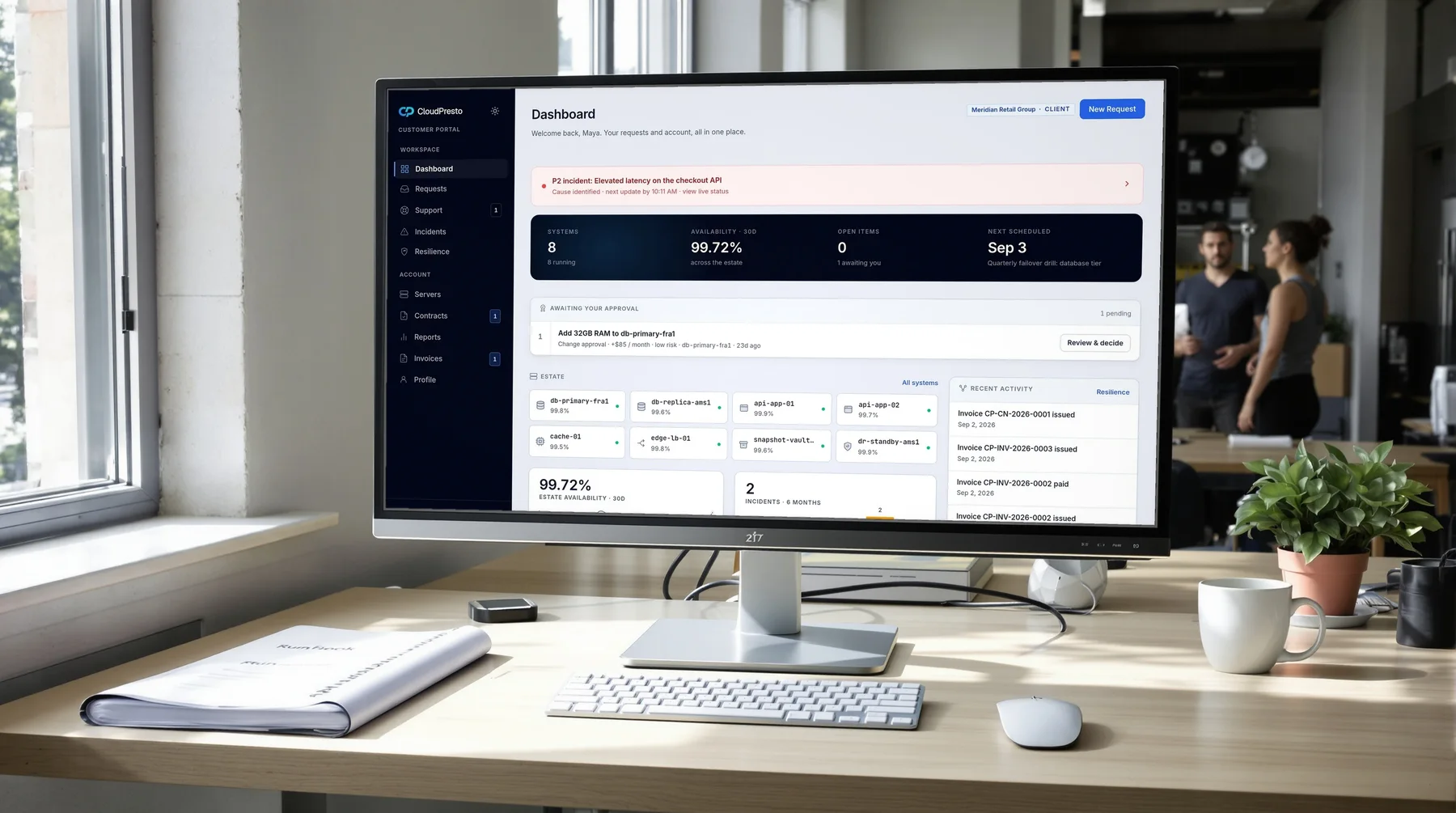
Backups, in the portal
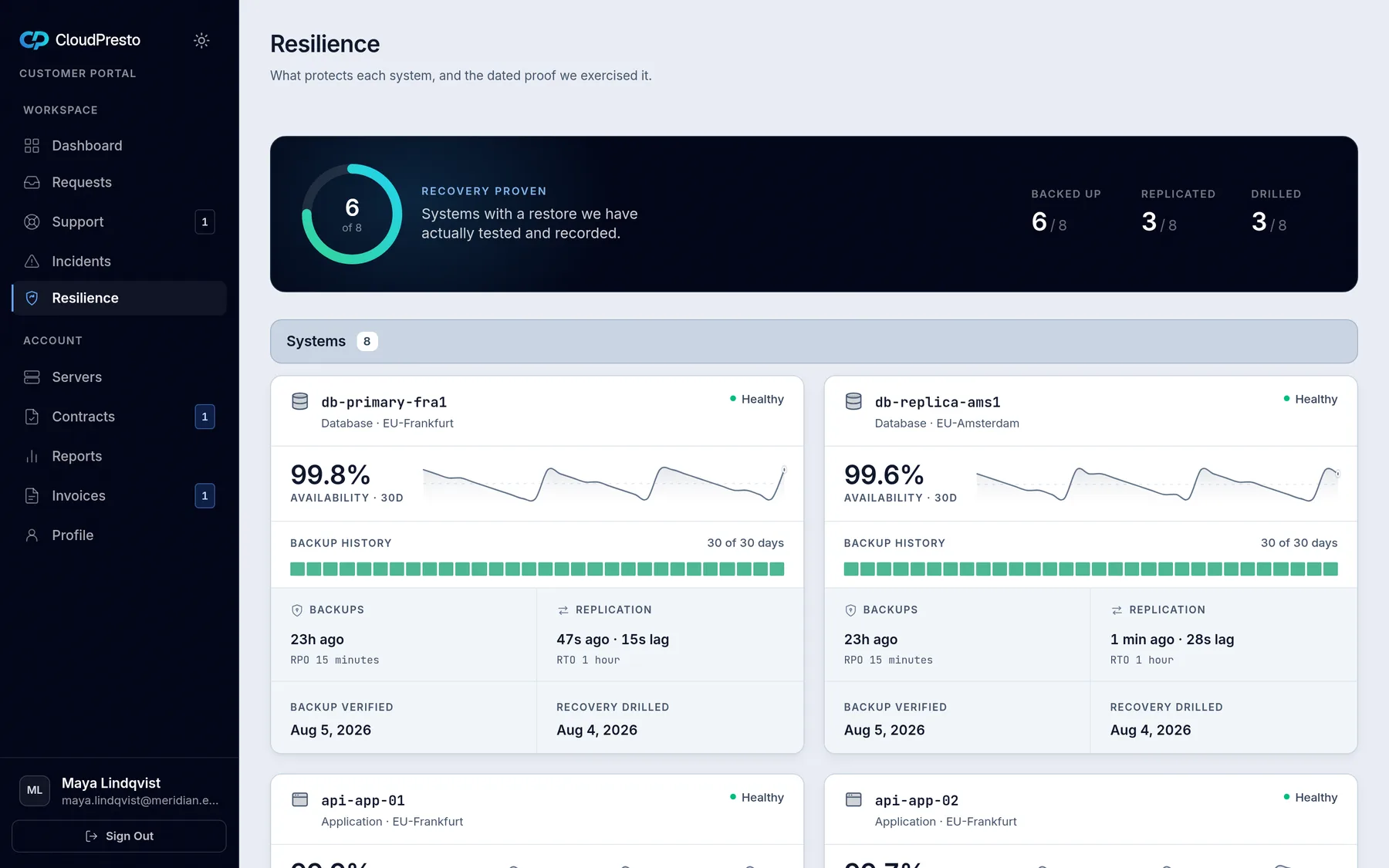
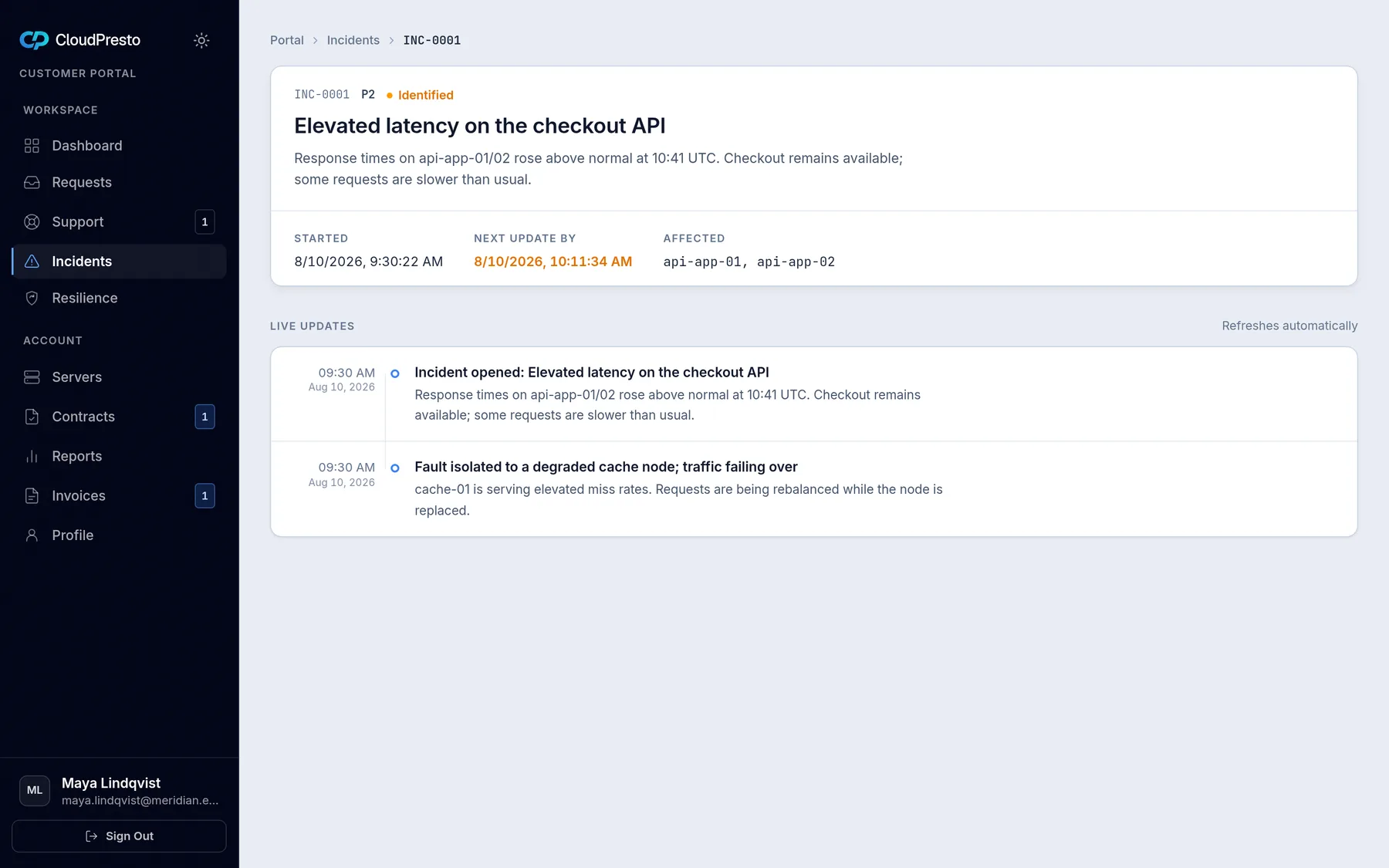
What an incident leaves behind
Reality check
Every drill that reveals a gap is a future incident prevented. We track recovery confidence as a measured number, drill by drill.
Source: Cockroach Labs, State of Resilience 2025
drill-record_cross-region-failover.md
01# Quarterly failover drill · scheduled
02Scope: primary region loss, full estate
03Objective: recovery within contracted RTO
04T+0:00 primary region isolated (induced)
05T+0:0X [measured] monitoring pages, severity graded P1
06T+0:0X [measured] runbook DR-04 invoked, failover begins
07T+0:0X [measured] traffic served from standby region
08T+0:XX [measured] data verified against RPO
09Findings: what was slow, who owns the fix
10Next drill: [date] · set in the retro
The difference
Traditional DR treats failure as exceptional and files a plan away. Resilience engineering treats it as inevitable and rehearses the recovery: replication that runs, failover that is drilled, targets that are validated, and a record of every drill.
| Traditional DR · most managed providers | CloudPresto resilience engineering | |
|---|---|---|
| Backups | Nightly backups, retention by policy. Restores tested on request. | 3-2-1+1 in every package: three copies, two systems, one offsite, one on another continent, every copy restore-verified on a schedule. |
| Failover | A documented DR plan with a secondary site, reviewed annually. | Cross-region replication and failover runbooks rehearsed against production, so traffic moves to a healthy region under the same runbook every time. |
| Drills | An annual tabletop exercise. | Quarterly failover drills that produce a dated drill record: objectives, steps, timings measured on the day, what was fixed. |
| Command | Escalation through the on-duty engineer and the account manager. | Clear authority paths for failover, rollback and customer communication under time pressure, written before the incident. |
Get started
Assess your current recovery posture, identify critical gaps, and design a continuity architecture that actually works under pressure. Three questions on the right give you a first grade; the review turns it into a plan, and the first drill is its first deliverable.
Assessment
Can you survive data loss?
1 / 3
Pick an answer to continue
Go further
Collection
Everything you need to understand how we engineer resilience and recovery.
Collection
Detailed guides on backups, replication, drills and incident command.
Guide
The 3-2-1+1 floor, restore verification, and what georedundancy buys you.
Guide
How a quarterly failover drill is run, timed and recorded.

